
Image of Jupiter taken by Peter McGregor 12 minutes after an impact.
20 years ago, comet Shoemaker-Levy 9 made headlines around the world when it crashed into Jupiter. The impacts produced the biggest planetary explosions scientists have ever seen.
Astronomers were able to calculate that Shoemaker-Levy 9 had passed so close to Jupiter two years before impact that the giant planet’s powerful gravity had pulled the comet apart into fragments.
Shoemaker-Levy fragments flying through space two months before impact. Fragment G caused the explosion shown in the image page top. Hubble Image from NASA.
Don’t make the mistake that the word ‘fragment’ here means these were tiny particles. Three of the fragments were 1 km or more across.
This was a science story so big that it made headlines all over the world. The single explosion shown page top released the same amount of energy as a simultaneous detonation of 400 million Hiroshima sized nuclear bombs.
Jupiter’s clouds were left with dark scars where the impacts took place, which lingered for weeks.
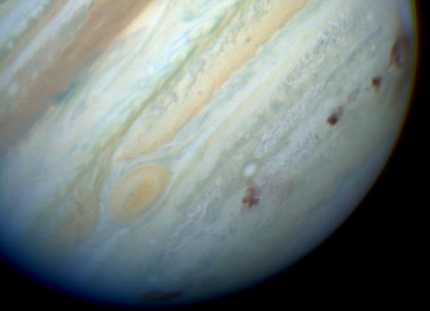
Jupiter following the impacts. The dark patches caused by the impacts are as big as planet Earth.
You can read more about the impacts on our Gene Shoemaker page.
So, What’s Been Happening Since?
Just last year, the Herschel Space Observatory captured this image, showing water in Jupiter’s stratosphere.
Image by ESA/Herschel/T. Cavalié et al.; Jupiter image: NASA/ESA/Reta Beebe (New Mexico State University)
A minimum of 95 percent of this water actually came from Shoemaker-Levy 9 when it vaporized in Jupiter’s atmosphere. The highest water concentrations are in the cyan/white areas of the image. The highest concentrations are in Jupiter’s southern hemisphere, where the comet struck.
Clearly, after 20 years, Jupiter is still feeling the effects of the comet impact!
But Wait, There’s More (Impacts)
Most of the scientists who were involved in the Shoemaker-Levy 9 observations felt they were watching a once-in-a lifetime event. However…
In 2009, astronomy enthusiast Anthony Wesley was imaging Jupiter from his backyard in Murrumbateman, Australia. A dark patch caught his eye, a patch which reminded him of one of the biggest astronomy stories he’d known in his life.
It looked very much like the scars he had seen on Jupiter from Shoemaker-Levy 9’s impacts.
Anthony Wesley quickly let the world’s astronomy community know what he had seen.
Telescopes around the world turned to focus once again on Jupiter.
And, sure enough, there it was… a new impact scar.
Jupiter scar from impact in 2009. NASA image from the Hubble Wide Field Camera 3.
Experience with the Shoemaker-Levy 9 impacts allowed astronomers to estimate the object that hit Jupiter in 2009 was a few hundred meters across.
So what else does the 2009 impact tell us?
The 2009 collision means that:
Either impacts are much more frequent than astronomers thought. Most astronomers thought there wouldn’t be another major impact on Jupiter for hundreds of years…
Or
We’ve been lucky to see such rare impact events twice within the space of 15 years.
I don’t know about you, but personally, I’m hoping it’s the latter of these two possibilities!